Listing Selection Cheat Sheet: Which Homes to Advertise
By Ray Wood, Founder of AdMachine · 25 November 2026
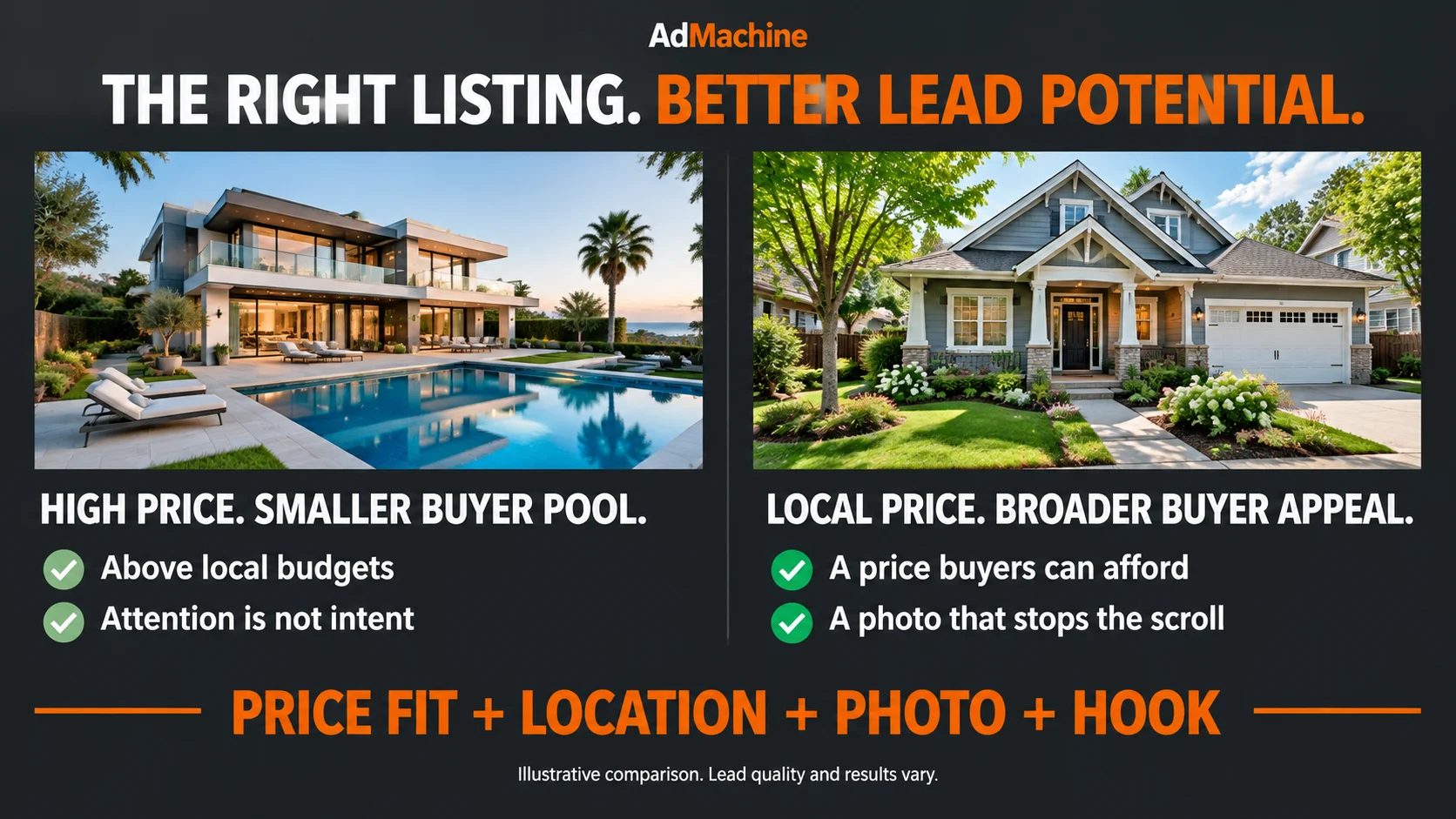
If you've been following my Ideas articles and seeing exactly what the agents I work with are doing to generate leads, you'll know that Leads on Autopilot is a real, tangible thing. It's not just an idea. It's a practical way to drive the future growth of your brand.
The listings you choose to promote using AdMachine will have a major influence on both the number and the quality of leads you generate.
There's a formula, and it works like this:
That gives your campaign a stronger starting point for attracting buyer leads and reaching nearby owners who may become your next sellers. Use the following checklist as a practical guide, not a guarantee of cheap clicks or lead quality. Your market, campaign and follow-up still matter.
1. Price: the most important filter
Start with the suburb's median price and, more importantly, the price band where the most homes actually sell. A useful starting range is 80–110% of the suburb's median price.
- Look at or slightly below the median. An accessible family home or first-home purchase can appeal to a broader buyer pool than a premium property.
- Make the price work in the headline. A clear hook such as “Under $800K in [Suburb]” gives buyers something concrete. A property at $810K cannot honestly use that hook.
- Separate a brand campaign from a lead campaign. Above 1.5 times the local median, the affordable buyer audience may be much smaller. A $2 million home in a $1 million suburb may showcase your agency beautifully without being your best choice for generating a volume of buyer leads.
These are selection guidelines, not valuation rules. Use current local sales evidence and the listing's real price guide.
2. Location: give locals a reason to stop
A recognised, sought-after suburb or street name can be a hook on its own. Look for the things local buyers already talk about: schools, transport, cafés, parks or the beach.
“The most affordable home on a sought-after street” is a compelling angle when the facts support it. It signals an opportunity people can understand quickly. Only describe a home as the “cheapest” if you can substantiate that comparison.
3. Property type: follow demand, don't fight it
Match the home to what buyers want in that area. In a family suburb, that may mean a three- or four-bedroom home with a backyard. In an inner-city neighbourhood, it may mean a two-bedroom apartment near transport.
Choose the property type your local market is actively buying, rather than assuming the most unusual listing will produce the best leads.
4. Looks: apply the scroll test
Can one photo communicate the appeal without an explanation? A renovated kitchen, pool, view, bright living space or great backyard can give people an immediate reason to look.
- Use professional photography with a strong lead image.
- Add a short vertical walkthrough video for Reels and Stories where available.
- Choose a photo that makes the benefit obvious on a phone screen.
- Avoid weak or phone-quality images that undersell the property.
If the appeal takes three sentences to explain, find a clearer photo or a stronger angle.
5. A hook or story: make the headline specific
A genuine story gives people a reason to notice the listing. Examples include:
- “First time on the market in 40 years.”
- “Under $700K in [Suburb].”
- A renovator with clear potential.
- A studio, a giant shed, a rooftop deck or a pool at an accessible price.
Renovators and estate sales can prompt interest, but use sensitive, vendor-approved wording. Keep every hook accurate. Comments and curiosity are useful signals, not proof that someone is a qualified buyer.
6. The seller-lead angle: your next listing could be nearby
Pick homes on streets with lots of similar properties. A neighbour who sees your campaign may start thinking, “What's mine worth?” Your listing ad can show them how you market a home like theirs.
Consider the surrounding neighbourhood as well as your buyer audience. The cheat-sheet starting point is a 1–3 km radius, but housing-ad targeting rules differ by market. Use only the geographic options and minimum radius permitted by Meta for your campaign; a tight radius may not be available.
Once the sale is confirmed, a “Just Sold” campaign can continue the conversation with nearby owners. Ask buyer leads whether they have a property to sell, rather than assuming every buyer is also a seller.
7. Timing and logistics: be ready before you launch
- Prioritise new listings. Aim to launch within the first 14 days on market, while the property is fresh.
- Have an open home date ready if that is your call to action.
- Show a price or price guide wherever possible, consistent with local advertising requirements.
- Keep the status accurate. If it is under offer, update the campaign accordingly. Only switch to “Just Sold” when the sale status supports that wording.
- Get the vendor's agreement to the campaign and advertising spend before it runs.
8. Listings to reconsider for a lead-focused campaign
- Luxury homes far above the suburb's median price.
- Properties with obvious drawbacks and no credible alternative angle.
- A main road or power lines dominating the lead photo.
- Dated interiors without a clear renovator story.
- Poor-quality photography.
- Campaigns where the vendor has not agreed to the advertising.
These properties can still sell. The question is whether they are the best use of this particular lead-generation budget.
9. Score it before you spend
Rate each listing from 1 to 5 on each of the five factors below. Use 18 or more out of 25 as your starting threshold for a lead-focused campaign. A score helps you compare listings consistently; it does not predict campaign results.
| Factor | 1 = Weak | 5 = Strong |
|---|---|---|
| Price fit | Way above or below median | At or just below median |
| Location appeal | Limited local demand | Sought-after suburb or street |
| Photo appeal | Average, needs explaining | Thumb-stopping lead photo |
| Hook or story | Nothing distinctive | Clear, accurate headline hook |
| Neighbour density | Isolated or one-off home | Street full of similar homes |
10. No qualifying listing? Run these instead
- “What $X buys you in [Suburb]”: a carousel of homes currently on the market, using images and listing information you have permission to advertise.
- “Just Sold”: a confirmed sale promoted to the surrounding area, within permitted targeting options.
- “Coming Soon”: a vendor-approved teaser to build buyer interest before launch.
Choose for genuine leads, then follow up
The best listing is not necessarily your most expensive or impressive home. It is the one with a realistic price, broad local appeal, a strong photo and a clear reason for the right people to get in touch.
Use AdMachine to create and test your ads, then judge the campaign by more than clicks. Look at how many leads answer your follow-up, match the property's price range and take the next step towards an inspection or conversation.
Lead Machine helps keep those leads organised and your follow-up working. Fast, relevant responses help you distinguish genuine interest from casual browsing and stay in touch with people whose move is further away.
Want to see how the system works with your next listing?